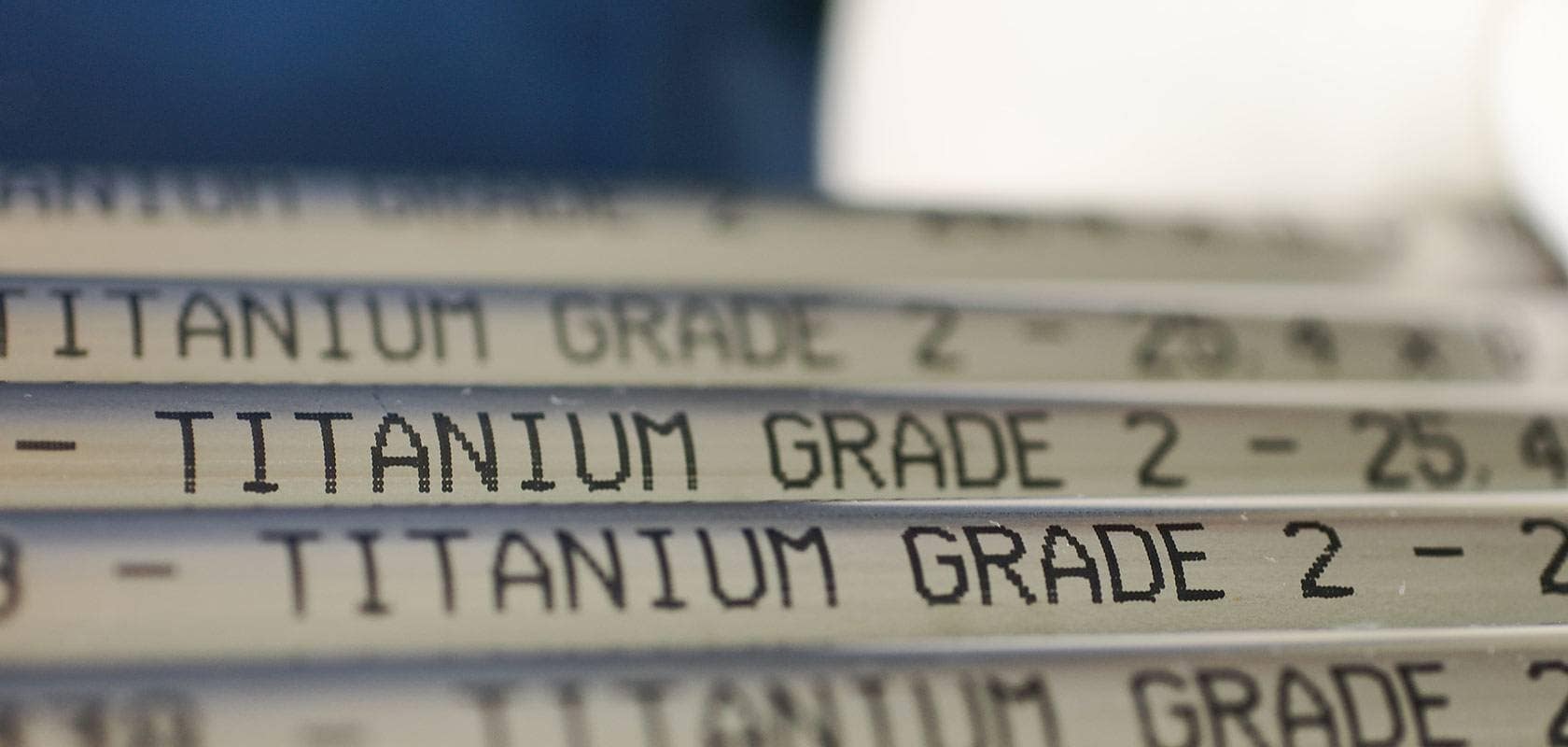
A shell-and-tube heat exchanger in titanium is normally built from two mill products in the same grade: tube to ASTM B338 (ASME SB-338 for pressure duty) and tubesheet, baffle and shell plate to ASTM B265. Grade 2 titanium (UNS R50400) is the standard choice for both — the tube and tubesheet have to be joined, and joining is simpler when both sides are the same commercially pure grade.
Why the Tube and the Tubesheet Are Usually One Grade
The tube-to-tubesheet joint is where an exchanger most often leaks, and it is a dissimilar-material problem before it is a welding problem. One grade keeps thermal expansion matched, keeps the weld metallurgy identical so no brittle intermetallic phase forms, and puts the whole wetted boundary under one certificate set. Where the shell is carbon steel, the tube en titanesheet is clad or explosively bonded, or the waterbox is lined.
The Tube Side: ASTM B338 Grade 2
Tube is normally supplied annealed, seamless or welded, in typical condenser sizes around 19.05 mm OD by 0.89 mm wall (3/4 in by 20 BWG) and 25.4 mm OD by 1.24 mm wall (1 in by 18 BWG). Minimum annealed properties are typically 345 MPa tensile and 275 MPa yield, per the standard.
- Seamless or welded — both are permitted; the purchase order should state which, not the mill.
- Straight or U-bent — U-bundle tube needs the bend radius and heat treatment stated; the bend is where wall thinning is checked.
- Testing — hydrostatic or pneumatic pressure testing plus eddy current to ASTM E426; add a helium leak test for vacuum or refrigerant duty.
- Surface — pickled and annealed is normal; the inside surface matters most, as that is where fouling starts.
The Sheet Side: ASTM B265 Plate for Tubesheets and Baffles
Tubesheet thickness is a design calculation, not a catalogue number: it comes from design pressure, tube-hole ligament efficiency and the corrosion allowance. What the mill controls is the plate — thickness tolerance, flatness, chemistry and properties to ASTM B265 Grade 2 — and whether it arrives cut to size instead of being machined away by the fabricator. Baffles and support plates come from the same plate.
Matching Wall Thickness to the Duty
Treating wall thickness as a pressure calculation only is a common mistake. Titanium’s corrosion resistance comes from a passive oxide film, and the film needs metal underneath it. Thicker tube is specified where the tube-side fluid carries solids and inlet erosion is a real wastage mechanism, where high velocity makes vibration a design concern, where U-bending thins the outside of the bend, or where the exchanger is expected to be retubed.
Grade 2 also has limits: continuous service in air is typically quoted at around 300–400 °C, and crevice corrosion becomes a consideration in hot chloride service above roughly 70 °C. Both are reasons to state the duty on the enquiry rather than order by grade name.
Tube-to-Tubesheet Joints: Expanded, Welded, or Both
Three options are used, and the choice belongs in the specification:
- Roller expanded — fast and standard for moderate pressure, provided the tube holes are correctly sized.
- Welded only — for aggressive tube-side fluids and vacuum duty; needs inert-gas shielding on both sides.
- Expanded plus seal weld — the usual arrangement for seawater and chloride duty.
Joints are verified before the bundle is closed: penetrant testing on welds, a pull-out test on a sample joint, and a shell-side hydrostatic or helium test.
What Belongs on the RFQ
| Item | State on the enquiry |
|---|---|
| Tube | OD × wall, tolerance class, seamless or welded, straight or U-bent with radius, quantity and length |
| Tube standard | ASTM B338 or ASME SB-338, grade with UNS number, condition (annealed) |
| Plate | Tubesheet thickness, diameter or cut-to-size shape, baffle thickness, ASTM B265 Grade 2 |
| Testing | Hydrostatic or pneumatic, eddy current, penetrant on welds, helium leak, flattening or flaring samples |
| Documents | EN 10204 3.1 mill test report tied to heat numbers, PMI report, dimensional and test records |
| Emballage | End caps, crates, tube ends protected, marking matching the bundle drawing |
Enhanced Tube, When the Duty Calls for It
Seawater condensers and chillers often use low-fin (integral finned) tube instead — commercially pure Grades 1 and 2, fins cold-rolled from the wall, typically 30 to 43 FPI at 0.5–0.8 mm fin height. That is a reference range, not a catalogue: the configuration is confirmed against the drawing and the duty, and plain ends stay unfinned so the tube can be expanded into the tubesheet.
Ordering Tube and Plate as One Release
FDtitanium is a titanium tube manufacturer, and heat exchanger packages are released as one controlled order: tube produced to ASTM B338 in Grade 2, plate cut to the tubesheet and baffle drawing to ASTM B265, incoming material verified by PMI against the mill certificate, tube tested by hydrostatic pressure and eddy current, and one document package issued with the shipment. MOQs run from a trial bundle to a full retubing release, and one accountable contact owns the order from drawing review to dispatch.
For the material background behind the grade, see Grade 2 titanium for corrosion service; for dimensional and standard options, see titanium tube and pipe.
Frequently Asked Questions
Is Grade 2 titanium suitable for a seawater heat exchanger?
Yes — it is a standard material for seawater condensers, coolers and desalination plant. Two things need checking: crevice corrosion at tight joints above roughly 70 °C, and any cathodic protection system, where hydrogen absorption should be reviewed against temperature.
Should I specify seamless or welded tube?
Both are permitted by ASTM B338 and both are used. Welded tube is common in condenser lengths and usually more economical; seamless is often preferred for higher pressure, U-bend duty or where the end-user specification demands it.
What wall thickness should a titanium exchanger tube be?
It is a calculation, not a default. Common starting points are around 0.89 mm for 19.05 mm OD and 1.24 mm for 25.4 mm OD, but erosion, vibration and the expected retubing interval can push the wall up.
Can tube and tubesheet plate be supplied together?
Yes, and it is the better way to buy them: one grade, one heat-number traceability chain, one certificate package, cut to the fabricator’s drawing.
Request a Heat Exchanger Material Quote
Send the tube schedule, tubesheet drawing and required test and document scope to FDtitanium and we will return an offer stating the specification, condition, inspection scope, packing and lead time, so offers compare on the same basis.
 English
 French
 German