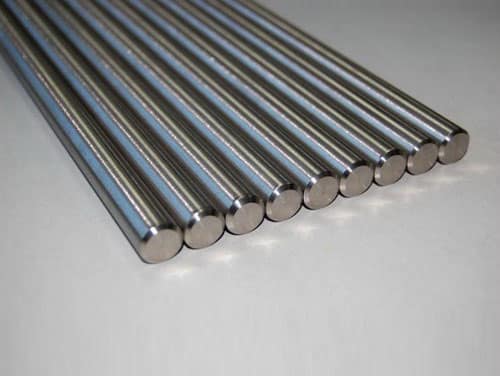
Grade 2 titanium (commercially pure titanium, UNS R50400) is the cheaper, more formable and more weldable of the two; Grade 5 titanium (Ti-6Al-4V, UNS R56400) costs more but delivers roughly three times the yield strength. The decision follows strength, temperature and corrosion duty — not the price per kilogram.
Both are titanium at almost the same density, so the same size often shows a 30 to 60 percent price gap, and buyers assume Grade 2 is the value option. That holds only when the wall is set by corrosion allowance and handling, not by stress.
What Actually Drives the Price Difference
Grade 5 is an alloy, not a purer metal. It adds about 6% aluminium and 4% vanadium through a master alloy, which lengthens the melt route, narrows the chemistry window and makes the thermomechanical schedule more demanding — more intermediate annealing, tighter cooling control, less tolerance for an off-spec heat treatment. It is also harder to machine and far less forgiving to cold form, so every downstream operation costs more.
Grade 2 is unalloyed with a wide chemistry window, so it melts, rolls, draws and welds at lower cost. The premium on Grade 5 is a percentage that moves with the alloy market, not a fixed number — ask for a current offer rather than an old price list.
Performance Comparison: Strength, Temperature and Corrosion
| Property | Grade 2 | Grade 5 | What it means |
|---|---|---|---|
| Annealed tensile strength, typical min | 345 MPa | 895 MPa | About 2.6× the load at the same section |
| Annealed yield strength, typical min | 275 MPa | 828 MPa | The real gap — Grade 5 stays elastic where Grade 2 yields |
| Density | ~4.51 g/cm³ | ~4.43 g/cm³ | Weight savings come from thinner walls |
| Thermal conductivity | ~22 W/m·K | ~7 W/m·K | Grade 2 conducts heat better — exchanger tube |
| Continuous service in air | ~300–400 °C | ~400 °C, creep-limited above | Neither is a high-temperature alloy |
| Hot chloride and crevices | Preferred for immersion | Not first choice in tight crevices | Seawater and brine point back to Grade 2 |
| Weldability | No post-weld heat treatment | Tight shielding, often stress relief | Field repair favours Grade 2 |
Figures are typical minimums per the applicable ASTM product specification; the mill certificate for the lot governs.
Where Grade 2 Wins on Total Cost
The commonest costing error is comparing grades on strength alone. In corrosion service the wall comes from corrosion allowance, handling damage and retubing interval rather than hoop stress, so Grade 5 strength buys nothing and its premium is pure cost.
- Forming — Grade 2 bends, flares and expands into a tubesheet without cracking; Grade 5 has limited cold ductility and more springback.
- Welding — inert shielding alone, with no post-weld heat treatment, removes a process step.
- Heat transfer — roughly 22 W/m·K against 7, one reason Grade 2 dominates titanium exchanger tube.
- Stock — more sizes and walls, so small quantities and short lead times are easier.
Where Grade 5 Earns Its Premium
Grade 5 pays back wherever the section cannot grow: fasteners, airframe fittings, hydraulic hardware and pressure parts inside a fixed envelope. A Grade 5 part at 40 percent of the Grade 2 wall saves weight, machining time and space — savings that outweigh the material premium several times over. Grade 23 (Ti-6Al-4V ELI, UNS R56407) is the low-interstitial variant used where fracture toughness and ductility matter, such as implants.
The Cost You Do Not See on the Quote
Material price is one line only. Grade 5 usually brings higher machining cost from tool wear and lower cutting speeds, a welding procedure with stress relief, and a forming route that may need warm working. Its traceability chain is also stricter, so swapping a heat, or a Grade 23 lot, into an approved part is far less flexible.
How to Choose: A Short Decision Rule
- Seawater, brine, hot chloride or chemical duty where strength is not binding — Grade 2.
- Load-bearing parts where weight or envelope is fixed — Grade 5.
- Continuous service above roughly 300 °C in air — Grade 5, or another alloy.
- Field welding without heat treatment — Grade 2.
- Still unsure — put medium, temperature, pressure and load in the enquiry and let the grade follow the duty.
Buying Both Grades From One Order
FDtitanium manufactures titanium tube to ASTM B338 and supplies bar to ASTM B348, plate to ASTM B265 and forgings to ASTM B381 in both grades, so a mixed bill of material ships as one controlled order with one heat-number chain and one document package. Incoming material is checked by PMI against the mill certificate — hand-held XRF separates Grade 2 from Grade 5 easily but cannot read oxygen, so the Grade 5 versus Grade 23 call must come from the mill analysis. Every lot ships with an EN 10204 3.1 mill test report, MOQs start from a trial quantity, and one accountable contact owns the order from drawing review to dispatch.
For the grade background behind the cheaper option, see Grade 2 titanium for corrosion service; for sizes, conditions and standards, see titanium tube and pipe.
Frequently Asked Questions
Is Grade 5 titanium worth the extra cost?
Only where the strength changes the design. If a Grade 2 wall already passes the pressure and corrosion calculation, Grade 5 adds cost with no benefit. If the section is fixed by weight or envelope, it usually pays for itself in the finished part.
Can Grade 2 be substituted for Grade 5?
Not without a design review. Grade 2 yields at about one third of the stress, so a straight swap either fails the load case or forces a much thicker wall. Going the other way is a design change too.
Which grade is more corrosion resistant?
Grade 2, in most aggressive aqueous service. Both depend on the same passive oxide film, but Grade 5 is more sensitive to crevice attack in hot chloride and is not the usual choice for immersion.
Can both grades be supplied in one shipment?
Yes. Tube, bar, plate and forgings in both grades can be released together with separate mill certificates per grade and lot, keeping a mixed bill of material on one schedule.
Request a Grade Selection Quote
Send the duty — medium, temperature, pressure and load — with sizes and quantities to FDtitanium, and the offer will state the grade recommended, standard and condition, inspection scope and lead time, so offers compare on the same basis.
 English
 French
 German