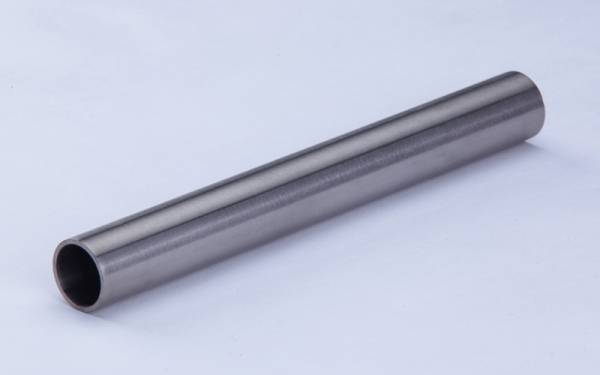
Titanium grades are registration labels, not a strength scale, so judging by the digits is where spec sheets go wrong. Grade 2, Grade 5 (Ti-6Al-4V), Grade 9 (Ti-3Al-2.5V) and Grade 23 are the four grades buyers compare most often. We also make Ti-6Al-4V bar and billet for buyers who need the alloy outside tube form. Grade 2 (commercially pure titanium, UNS R50400) is unalloyed. Grade 5 (Ti-6Al-4V, UNS R56400) is the alloy most of the world builds in. Grade 9 (Ti-3Al-2.5V, UNS R56320) sits in the middle and takes cold work. Grade 23 is Ti-6Al-4V ELI, or Grade 5 with tighter interstitial limits.
We see it often: a buyer pays for strength the part never needs, then finds out the grade will not bend when it reaches the bender.
How the Titanium Grade Numbers Work
Grade numbers are assigned as new chemistries are registered, so the sequence says nothing about load capacity. Grades 1 to 4 are all commercially pure titanium (CP), separated by oxygen: Grade 1 softest, Grade 4 strongest. Grade 5 was the first alloy registered, and nearly everything since varies an existing chemistry. Grades 7 and 11 add palladium for reducing acids, and Grade 12 adds molybdenum and nickel. Grades 9, 18 and 28 are the Ti-3Al-2.5V family; Grade 19 is a beta alloy with a different chemistry. Grade 23 is Grade 5 with tighter interstitial limits, while Grades 24 and 25 add palladium or nickel for corrosion resistance.
So the number alone tells you little. Grade 9 tests between Grades 2 and 5. Grade 12 is specified for corrosion resistance in reducing acids; strength is incidental to that choice.
The Four Titanium Grades Compared
| Grade (UNS) | Base chemistry | Oxygen, max | Typical min UTS / yield (MPa) | Where it is normally chosen |
|---|---|---|---|---|
| Grade 2 (R50400) | Unalloyed CP titanium | 0.25% | 345 / 275 | Exchanger tube, tube sheet, plate, chemical plant |
| Grade 5 (R56400) | Ti-6Al-4V | 0.20% | 895 / 828 | Fasteners, airframe fittings, pressure parts |
| Grade 9 (R56320) | Ti-3Al-2.5V | 0.15% | 620 / 483 annealed; 860 / 725 CWSR | Seamless hydraulic, bicycle and instrument tube |
| Grade 23 (R56407) | Ti-6Al-4V ELI | 0.13% | 860 / 795 | Implants, cryogenic, fracture-critical parts |
Figures are typical minimums per the applicable ASTM product specification, in the annealed condition unless stated; the mill certificate for the lot governs, and the specification and revision should be stated on the purchase order. The composition of Ti-6Al-4V is documented in reference materials such as NIST SRM 654b (Titanium-Base Alloy, 6Al-4V, UNS R56400).
What Actually Changes Between Titanium Grades
- Alloying. Aluminium and vanadium in Grades 5 and 9 raise strength and cut ductility. Unalloyed Grade 2 forms and welds easily, but yields at a third of Grade 5.
- Interstitials. Oxygen, nitrogen and carbon strengthen CP titanium, which is why Grades 1 to 4 exist. ELI grades go the other way: lower oxygen buys toughness at some cost in minimum strength.
- Condition. The same grade in another condition is another material. Annealed Grade 9 yields at about 483 MPa; cold worked and stress relieved, roughly 725 MPa, with elongation down to about 10 percent.
Titanium Grades in Tube: Ti-3Al-2.5V vs Grade 2
On tube, you pick the grade after you know what is going inside it. Where the wall is set by corrosion allowance and the stress never gets close, it is a condenser, a cooler or a chemical heat exchanger — and Grade 2 does the job. Where the tube has to be bent, flared and welded on site, annealed Grade 9 tubing yields at 483 MPa against Grade 2’s 275 and still moves under the tooling. That is how it became the aerospace hydraulic standard. Grade 5 tube is what you specify when pressure or envelope sets the wall, and you accept that it fights you at the bender.
In practice, buyers get caught on finned tube. Integral low-fin and other enhanced-surface tube is normally made from Grades 1 and 2, because you cannot cold-roll fins into a metal that will not flow. Ask for an alloy fin and it becomes a special enquiry, confirmed against the drawing and RFQ.
Where Grade 23 Fits
Grade 23 tests lower than Grade 5, and that is deliberate. Oxygen is capped at 0.13 percent, iron and nitrogen are tightened with it, and what those limits buy is fracture toughness plus ductility that holds at cryogenic temperature. That is why buyers for implants and cryogenic service ask for Grade 23 (Ti-6Al-4V ELI) by name, the low-interstitial counterpart to Grade 5 in aerospace and medical implant applications. Load-driven parts call for Grade 5. Grade 23 is for parts where fracture behaviour at low temperature is the deciding requirement.
Reading a Titanium Grade Callout Correctly
A grade on its own does not give a mill enough to quote against. What we need is specification, condition and size, written the way a purchase order reads: “ASTM B338 Grade 9, annealed, 25.4 mm OD x 1.24 mm wall”. Ti-3Al-2.5V also appears under aerospace hydraulic specifications such as AMS 4943 and AMS 4944, and those bring tighter interstitial limits and a one-sided OD tolerance. Same grade name, different qualification route, and no one swaps them without a design review.
Buying Several Titanium Grades on One Order
FDtitanium manufactures seamless and welded titanium tube to ASTM B338 and supplies bar to ASTM B348, plate to ASTM B265 and forgings to ASTM B381, in Grades 2, 5 and 9. A bill of material that mixes those grades ships as one order, with one heat-number chain. We verify grade identification by PMI against the mill certificate before material reaches the floor. Hand-held XRF separates the grades on alloy content but cannot read oxygen, so a Grade 5 against Grade 23 call has to come from the mill analysis. Every lot ships with an EN 10204 3.1 mill test report. Trial quantities are accepted as a starting MOQ, and one contact owns the order from drawing review to dispatch.
If cost decides before specification does, start with Grade 2 vs Grade 5 cost and performance. Sizes, conditions and standards sit under titanium tube and pipe.
Frequently Asked Questions
Is a higher titanium grade stronger?
No. Grade 5 has the highest minimum UTS of the four at 895 MPa, even though Grade 9 and Grade 23 carry higher grade numbers. Grade numbers record when a chemistry was registered. Among the pure grades, Grade 1 is softest and Grade 4 strongest; Grade 23 is the lower-strength ELI version of Grade 5.
What is the difference between Grade 2 and Grade 5 titanium?
Grade 2 (Gr2) is unalloyed and yields at about 275 MPa. Grade 5 (Gr5, Ti-6Al-4V) adds 6 percent aluminium and 4 percent vanadium and yields at about 828 MPa, roughly three times as much. Grade 2 gives up strength in exchange for formability, weldability, heat transfer and a lower price.
How do I tell Grade 5 from Grade 23?
You cannot, not with a hand-held analyser. Both grades read as Ti-6Al-4V because the alloying elements are identical. The difference is interstitial oxygen, which only a lab analysis or the mill certificate can confirm.
Can I order several grades in one shipment?
Yes. Each grade and heat gets its own mill certificate, and the whole bill of material moves on a single schedule.
Ask for a Grade Recommendation
Send us what is inside the tube, the temperature, the pressure, the load and any forming you plan to do, with sizes and quantities, to FDtitanium, a titanium tube manufacturer. The offer states the grade, specification, condition, inspection scope and lead time, so you can put it beside another supplier’s quote line for line.
 English
 French
 German